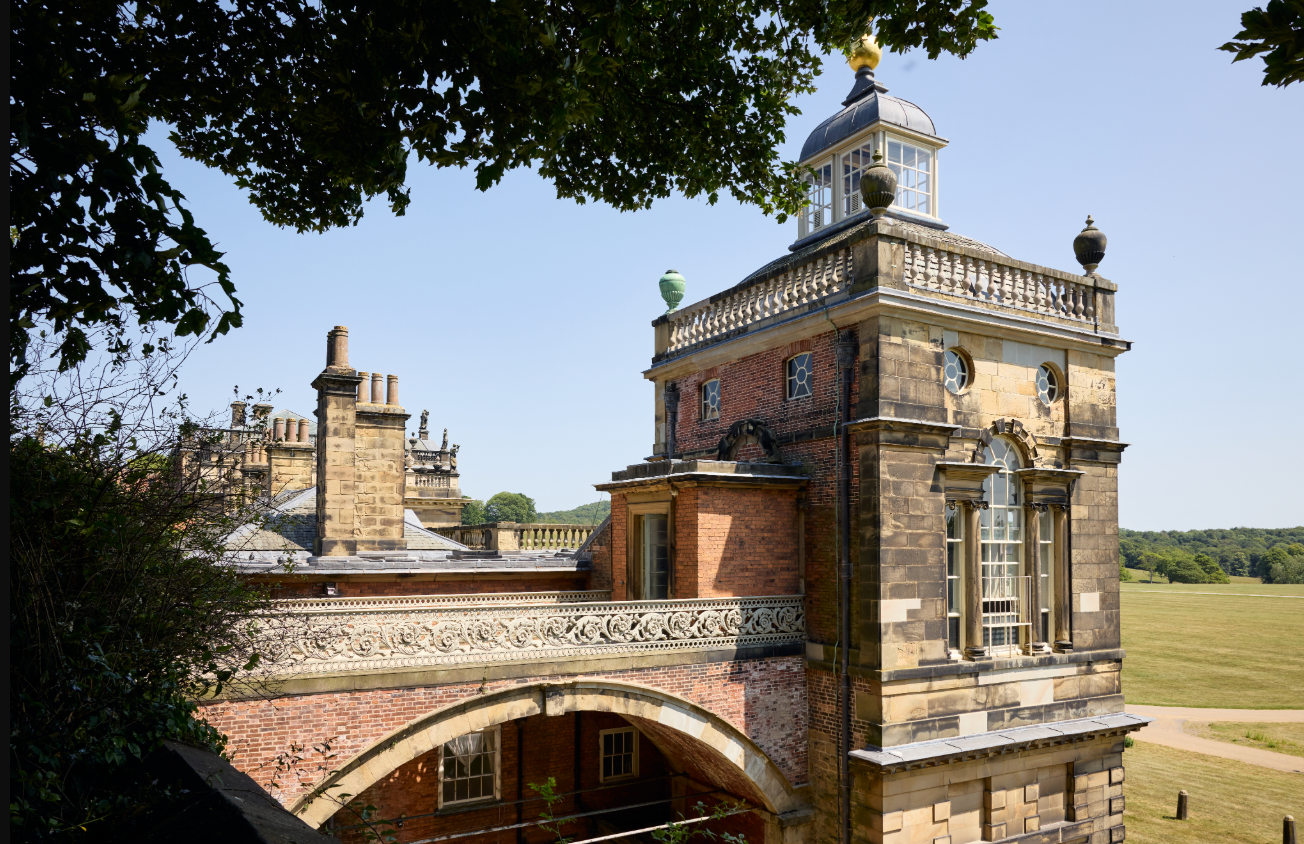
Within a house of power and pomp, sits a chamber of exquisite elegance waiting to be restored.
The Landmark Trust has launched a fundraising appeal to support the restoration of the South Tower at Wentworth Woodhouse – a secluded eyrie and a rare survival of 18th century feminine taste within the monumental South Yorkshire mansion.
Building conservation charity the Landmark Trust hope to restore the South Tower to its 18th century heyday and create a self-catering apartment for anyone to stay in.
Wentworth Woodhouse, set in a rolling South Yorkshire landscape, is the creation of the 1st and 2nd Marquesses of Rockingham. Its vast Palladian-style East Front is longer even than Buckingham Palace, encasing stunningly opulent interiors.
Following years of decay, the derelict mansion was bought in 2017 by the Wentworth Woodhouse Preservation Trust (WWPT), who have embarked on the herculean task of restoring the place back to its former glory in a multi-phase project.
The Landmark Trust are now working with WWPT to save the South Tower, which sits at the most southerly tip of the building’s vast frontage. The tower’s fine upper chamber offers outstanding vistas of house and grounds and is reached via its own private footbridge.
WWPT carried out urgent external repairs to the South Tower in 2022. Yet inside this quiet hideaway, the once opulent plasterwork is crumbling, an exquisitely decorated ceiling has been lost and an elegant staircase is undermined by dry rot.
History
The 1st Marquess completed Wentworth Woodhouse by 1748 as a seat of regional and national power. Charles Wentworth-Watson, 2nd Marquess, who was twice Prime Minister and instrumental in American independence, then set to work on its lavish interiors.
The South Tower, with its glorious parlour, was chosen by the 2nd Marchioness of Rockingham to be her personal retreat. The parlour itself is a single room in the upper part of the tower, which the Marchioness, Mary Watson-Wentworth, probably used mostly in summer. Under her direction in the mid-1770s the architect John Carr of York completed its interior, with its marble chimney piece, oval plaster reliefs of antique subjects and beautiful decorative ceiling. A contemporary inventory indicates that it was used both for business and entertaining. At her sycamore writing table the Marchioness wrote copious letters, including many to her husband, in whose political career and Whig ministry she played an important role.
After its aristocratic heyday in the late 18th and 19th centuries, when over 1,000 guests would attend legendary receptions and parties, Wentworth Woodhouse fell into disrepair. Open-cast coal mining in the 1940s and 50s came to within yards of the building’s rear façade and after a series of family tragedies it narrowly avoided demolition. A late reprieve, in its use as a training college for women PE teachers, ended in 1988 and by the early 21st century it was increasingly dilapidated and its future highly uncertain once again.
Saving the South Tower at Wentworth Woodhouse
In 2014, a group of campaigners established the Wentworth Woodhouse Preservation Trust (WWPT) and raised the funds to acquire the vast house with over 300 rooms in 2017 – embarking on the immense and daunting task of repair and adaptation for new charitable purposes.
They approached the Landmark Trust to ask whether we might play a part, and we identified a discrete and delightful element of the building – the Marchioness’s Parlour in the South Tower – as the perfect place for people to stay, if it could be saved in time.
However, the South Tower needs urgent action. The Landmark Trust plans to repair the grandest room with traditional 18th-century skills using the finest craftspeople and their apprentices. As of now, the plaster ceiling has come down and black plastic sheeting fills its place, a marble panel by the brilliant English sculptor Joseph Nollekens had been removed for safety and dry rot is already engulfing the timber floor.
Next steps
The Landmark Trust are now poised to act – to take on a long lease from the WWPT and develop a holiday let for two. The parlour would become the drawing and dining room, and a bedroom, kitchen and bathroom would be created in the adjacent rooms. The approach would be, as it was from the first, via a handsome private footbridge from the elevated rear terrace.
Within the parlour, traditional 18th-century techniques would be used to re-create the Marchioness’s lost ceiling, guided by historic photographs, and drawing on the inventory to furnish her elegant chamber to evoke its character in its prime.
Without Landmark’s intervention, the South Tower will linger in dangerous deterioration at the furthest reach of the building, as this elegant room succumbs to damp and decay. This upper chamber is a rare and exciting survival of undiluted female taste in the 18th century.
Dr Anna Keay OBE, Director of the Landmark Trust says:
“There really is nowhere that compares to Wentworth Woodhouse. This monumental Palladian palace in South Yorkshire is a miraculous survival. When I first saw this fascinating room a few years ago, I was struck by its combination of grandeur and intimacy, the glorious views south and west from its soaring sash windows, and by the perilous condition in which it stood. Two things were immediately clear: it needed urgent action to arrest its decay and – if we could just raise the necessary funds – it would make the most spell-binding place to stay.”
The Landmark Trust is thrilled that funding made available to the project thanks to the H B Allen Charitable Trust and generous donations from early project Guardians means that over 70% of the necessary funds have already been secured, leaving £303,000 still to find. If the final sum can be raised over the coming months, it could be possible to start work on site this summer and have the South Tower ready for booking in 2027.
The Landmark project to restore the South Tower at Wentworth Woodhouse will repair and secure a key part of a spectacular grade I listed country house. It will add Landmark’s skills and resources to arguably the most ambitious historic building undertaking of the age. In so doing, it will create a sublime place for guests to stay – and from which to experience this fascinating site and the astonishing revival that will continue to unfold over the years and decades to come.
To donate to the appeal or to find out more, including a detailed history of the South Tower, visit Landmark’s website:
