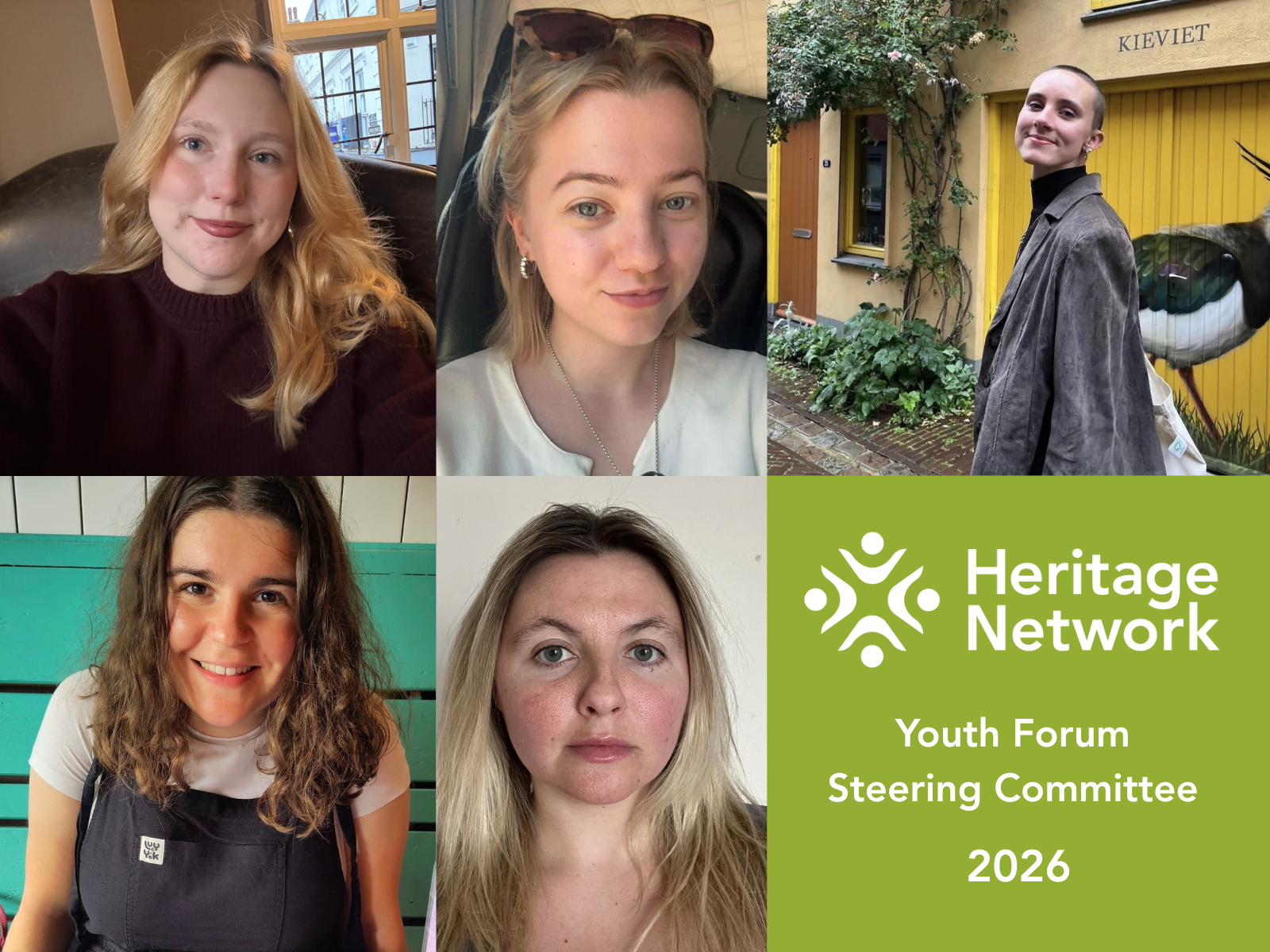
We are proud to announce the appointment of our new 2026 Youth Forum Steering Committee! A very warm welcome to Caitlyn Stewart, Rae Wnuk, Ellie Hartfield, Claire Taylor, and Niamh Barclay, who join Kate Breeze to form our 2026 Steering Committee.
Appointed from within the Youth Forum membership, our youth-led Steering Committee oversees the Heritage Network Youth Forum’s goals and activities throughout their term. This involves objective-setting, planning events, providing new ideas, and supporting subgroups (such as our Podcast, Advice Library, Heritage Skills, and Climate Action groups). Steering Committee members help coordinate the Youth Forum to stay active in the long term. They also choose one or two areas they would like to champion across their term, developing skills in areas that interest them.
Ultimately, the Committee are here to advocate for young people and early career professionals in the heritage sector, plan events and activities for our members, and ensure the youth voice in heritage is heard. If you want to get in touch with thoughts or ideas, contact youthforum@heritagenetwork.org.uk.
Meet the Committee
We asked our new Committee to tell us a little bit about themselves in their own words!
Caitlyn
My name is Caitlyn Stewart, I am 26, from Glasgow, Scotland. I currently study Classical Studies and Religious Studies at the Open University and now I am a part of the Heritage Network Youth Forum’s Steering Committee! As an autistic person, I wanted to bring a new perspective to light about the inclusivity of neurodivergent people in heritage and what that looks like. I think it is important that our voices are heard and being able to be a representative for autistic voices in this space is a privilege. As for a more personal touch, I love iced lattes (I’m never without one, yes even in winter), video games like the Sims 2, and travelling here, there and everywhere. This year alone I’ve been to London, Medjugorje in Bosnia and Rome. If I haven’t booked a flight you might need to check my temperature! I’m looking forward to connecting with everyone in the Youth Forum over the next year, representing autistic voices and learning the inner workings of being a part of the Steering Committee.
Rae
Hi! I’m Rae (they/she) from Dublin, Ireland. I’m passionate about all things heritage—especially Georgian architecture and mortuary landscapes! Over the past three years, I’ve worked with both public and private heritage organisations in Ireland, but I’m now taking a career break to pursue a Master’s in World Heritage Studies at Brandenburg Technical University. I’m thrilled to join this year’s steering committee and to focus on building a strong succession plan, ensuring past contributions continue to grow while creating a supportive, knowledge-sharing space for youth forum members at every stage of their journey.
Ellie
My name is Ellie Hartfield, I am 24, based in Hampshire. I have recently graduated with my Master’s in Cultural Heritage and Resource Management from the University of Winchester and am working a casual hour’s contract in a military museum as well as a recent fixed-term contract for the National Trust. By joining the Heritage Network Youth Forum Committee, I want to share my current experience within the heritage sector as a recent graduate and the hardships that come with getting a job in the sector. I think it is more important now than ever that young professionals and young inspiring professionals’ voices are being acknowledged and given a platform to express their ideas and concerns about the sector we hope to work in. Other than that, I am a big reader (mainly fantasy) and love getting wrapped up in a fictional world. Now that we’re coming into the cold, spooky season, if I’m not working or reading, I’ll most definitely be playing some horror games!
Claire
Claire Taylor joined the Youth Forum Steering Committee after completing her MPhil in Heritage Studies at the University of Cambridge. There, she saw how young people’s voices are often left behind in the heritage sector. She has an undergraduate degree in English and Modern History from the University of St Andrews, and currently works at the Andrew Carnegie Birthplace Museum in Dunfermline and at an Edinburgh Council Special School as a Pupil Support Assistant. As a PSA for students with additional support needs, her dedication to introducing history and heritage to all children has deepened. She is happy to chat about all things inclusivity and access in heritage with anyone interested!
Niamh
Niamh has a strong background in student engagement, research, and project management, with a focus on building museum-based learning, volunteer management, and leading co-curated initiatives. At Newcastle College University Centre, she lead the development of the Higher Education Student Voice system and led on Equality, Diversity, and Inclusion initiatives. Currently, Niamh is the Project Lead for The Durham Creative and Cultural Skills Hub, hosted through Beamish Museum, a countywide initiative designed to address skills gaps and create pathways into the creative and cultural sector for County Durham residents. Niamh has a background in Special Educational Needs and Disabilities (SEND), having worked as a SEND Advisor. Her MA research focused on Autism and museums, and she holds a PGCE with a specialism in SEND. Her current research interests include the role of heritage crafting as an innovative method of engagement for museums, galleries and heritage spaces.
A Conversation Between Members
The Youth Forum brings together young people at all stages of their careers, with wide-ranging interests that cover just about everything that could come under the umbrella of ‘heritage’. Our Steering Committee members are no different, and at the start of their Committee journey, members Ellie and Caitlyn met and discussed what motivates them, as well as the unique perspectives they have to contribute as young people interested in and/or working in heritage today.
What is your relationship with the heritage sector?
C: I’m currently studying an Arts and Humanities undergraduate degree with the Open University, focusing on Classical Studies and Religious Studies and heritage is quite an important topic in both subjects. I’m at a stage where I’m not entirely sure where my degree will take me when it comes to a heritage career, but I am looking forward to that journey ahead.
E: During my undergraduate degree, I wasn’t entirely sure where I wanted my career to go, so I started volunteering at a variety of heritage spaces, including archives, collection stores, and events. This led me to undertake my master’s degree in Cultural Heritage and Resource Management, which I recently graduated from. I am now working a casual hours contract as a Museum Assistant for a military museum and have also secured a fixed-term contract as a Programming Assistant elsewhere. I’m still very early on in my career and find myself learning more about the inner workings of different types of heritage organisations.
What are you keen on getting going with in the Youth Forum?
C: From the perspective of an autistic student, I feel that diversity is always important so I’m looking forward to not only giving other young autistic people in heritage more confidence in expressing their voice but also bringing EDI topics to the heritage table. I would also love to see more involvement in the Youth Forum with more chit-chatting about all things heritage, events for meeting each other, and other fun. Heritage doesn’t have to be serious all the time!
E: After a year out of university, with job applications filling my days, I’ve realised how tough it is for newcomers to break into heritage. Entry-level roles rarely feel truly entry-level, and young professionals often miss out on chances to learn and grow. Through the Forum, I want to shine a light on these challenges and amplify the voices of young professionals who face barriers to accessibility in the sector, hoping organisations will finally take notice. From my time in a military museum, I’ve seen firsthand that equality, diversity, and inclusivity are pressing issues everywhere in heritage. These EDI topics are not just buzzwords—they are vital for shaping the future of the field.
What is your experience as someone who works in the sector, Ellie?
E: It’s taken a lot of time and a lot of rejections to get to where I am now. And although I am so grateful for having these opportunities, neither of them is permanent nor creates a stable living environment. With where I am now and my experience, it’s hard not to get demotivated when hearing that a job you have applied to ended up going to someone with a lot more experience than you, even though it was advertised as an entry-level job and good for those starting in heritage. Having said this, I am very lucky that the teams I work with are an incredible bunch. They’ve given me many opportunities to gain new skills and advance on old ones.
With you being a student, Caitlyn, aspiring for a career in heritage, and for potential students that might be reading this, I think that it is important to know both sides. One side is the great opportunities and people you may come across, and the other is how hard it is to start within the field. I was never talked through this process and was almost always just told about the great things, which is why I feel passionate about joining this Steering Committee!
Caitlyn, what is your point of view as a student looking in at the sector?
C: I must admit, it is quite daunting and off putting. A lot of what I’ve heard about the heritage sector so far is that there is a lack of diversity, inclusion, career stability and accessibility, and the difficulty of getting a foot in the door. If I’m being offered a job that’s stable and flexible in another sector, I’m going to choose that over a contract that’s 0 hours and not accessible or flexible, which is unfortunate when you aspire to be a part of the growth and preservation of heritage.
How do you think the sector can best move forward?
E: Acknowledging, listening, and implementing. This is why I think that the Youth Forum is so great, giving us the platform to voice these concerns. If the sector acknowledges this gap of EDI issues and the lack of young professionals, listens to our concerns and recommendations, and allows us to work with them, then implementing these changes could benefit both sides greatly. The future of heritage relies on new generations wanting to be involved, so I think it’s time that they make space for us young professionals to be part of the sector’s future.
