By Youth Forum member, Nicole Donald.
For Easter weekend this year, I visited Liverpool with my family. We spent our first afternoon exploring the history of the Beatles – first by visiting the Beatles Story Museum on Albert Dock, and then by visiting the Cavern Club (an underground venue where the Beatles had often played early on in their career). Although I was familiar with some of Beatles’ songs, and passively enjoyed their music, I would not have considered myself to be a fan or expert before this trip. It is to these sites’ credit, then, that I was interested and engaged, and that I learned some new things.
The Beatles Story Museum
The Beatles Story Museum was set up in an immersive way, with various rooms recreating different environments and locations that were central to the group’s history. This included literal recreations of environments such as the office of the Mersey Beat newspaper or of Hesse’s music store. It also included some more abstract representations of ideas such as a hall of mirrors interspersed with posters and pictures of screaming fans. There was (of course) a yellow submarine. The inclusion of preserved items such as notes made while writing songs, and George Harrison’s first guitar, greatly enhanced the experience.
At times, it seemed that the museum shied away from fully addressing more difficult or controversial elements of the history. While arrests for drug use were mentioned in fact sheets on the guide, they were not mentioned in the museum itself or discussed in much detail. The group’s time with and break from Maharishi Mahesh Yogi and his Transcendental Meditation religion was mentioned. The the deeper conflicts associated with this stage of the band’s history, however, were not discussed in any meaningful way. This included divisions within the band over allegations of sexual misconduct on the Maharishi’s behalf, accusations that members of the band’s entourage had brought in forbidden drugs, and disagreements over money. This is in some ways understandable considering that it was an all-ages museum (I saw at least one young child during my time there).
Later on, the band’s break-up is introduced rather abruptly, and the reasons for it are not explored in much detail. This is in contrast to the multiple rooms dedicated to the band’s early years and rise to fame. I know that Liverpool also has another museum dedicated to the Beatles, The Beatle’s Museum. I imagine that this museum might focus more on the more serious and ‘adult’ elements of the story, leaving the Beatle’s Story free to focus more on art and creative vibes. But I cannot say for certain without visiting both.
One thing that the museum did a good job at highlighting was the importance of various figures connected to the Beatles. This included the wives of the band members, earlier band members who left before they became famous, family members, and, most of all, the music industry professionals who helped them become the sensation that they were. A lot of attention in particular was given to their second manager, Brian Epstein. This included his own family background and early career as a record store owner, as well has his personal struggles and eventual death. The influence he had on the band, including helping to shape their style and image, is thoroughly discussed. I learned for the first time that he had been a gay man. I am interested in queer heritage and try to learn about it
whenever I can, and this was still new information to me. I think it is very important to remember that the UK’s most famous band would not have achieved the success they did without the support of a gay, Jewish man.
Another thing that interested me was that one of the museum’s founders, Bernadette Byrne, had been personally familiar with the Beatles in their earliest days. An original frequenter of the Cavern Club, she had regularly attended shows as a teenager and had even dated both George Harrison and Paul McCartney. Historically, young female fans of The Beatles and similar bands were often dismissed as shallow “teeny boppers” chasing tends. Conservative commentators of the day described them in insulting and sexist terms. But Bernadette’s vital role in creating the museum shows both the important work that women like her do in preserving heritage, and how valuable they can be as sources of knowledge.
The Cavern Club
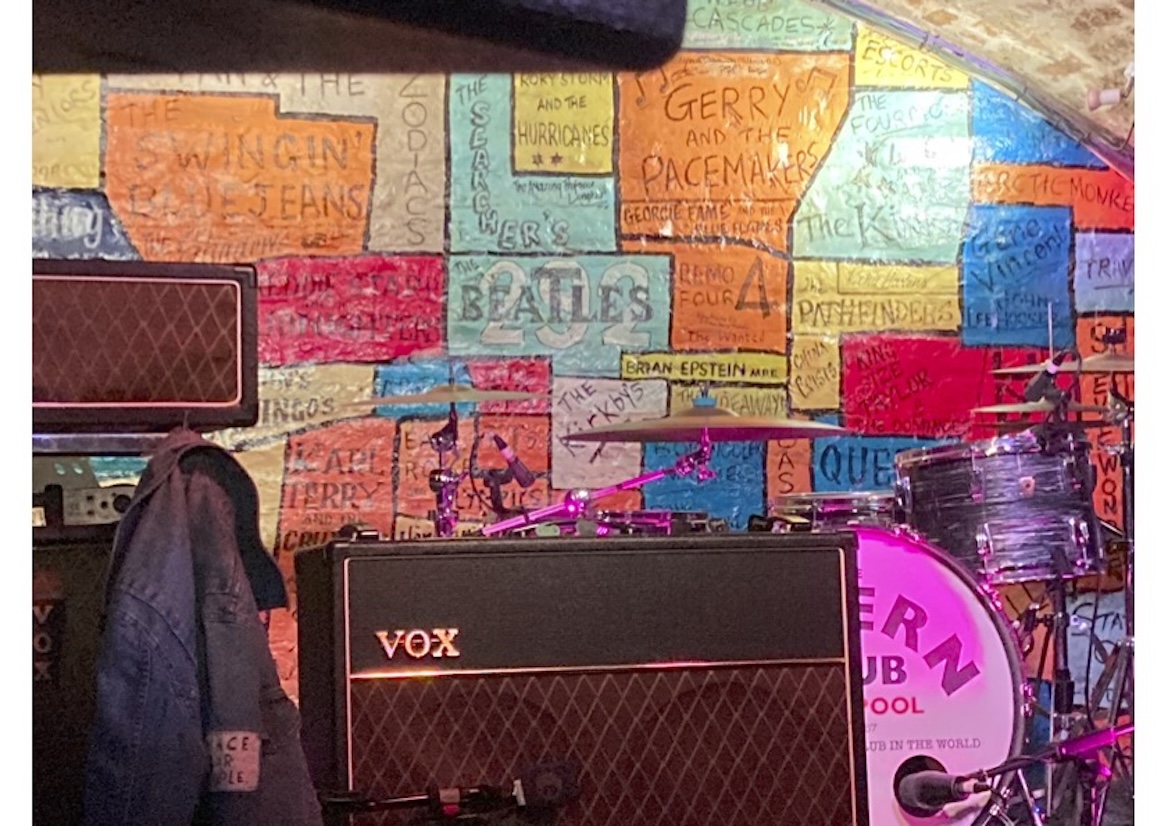
The history of the Beatles was preserved in a different way at the Cavern Club on Matthew Street. Although the original Cavern Club that the Beatles had played at was demolished in 1973, it was recreated using salvaged bricks from the original ten years later. The famous mural behind the stage, with the signatures of famous bands who had played there was similarly recreated, and the interior is a pretty faithful (although more hygienic) version of the original. Bands, many of which are local to the area, still regularly perform there. On the night I was there, a performer was playing covers of other bands, but other artists play their original work there on other nights. The street outside is filled with murals and statues commemorating not just the Beatles but many other famous musicians that got their start in Liverpool, including Cilla Black and Elvis Costello. There was even a statue of Brian Epstein nearby.
When managing heritage sites, there is often a trade-off between preserving things as they are, and recreating the spirit of a historic time and place. Should the interior of a medieval castle be painted to resemble what they would it looked like in its heyday? Or should the ruins be left untouched? Should a painting be restored? A machine repaired? These are not simple questions, and many heritage sites come to different conclusions. Both approaches have their value.
Both the Beatles Story Museum and the Cavern Club combine these approaches in their own unique ways. The museum displayed both genuine artefacts, such as the guitar, and recreations, including replicas of the costumes for the Sergeant Pepper’s Lonely Hearts Club album cover. There were historic video clips and recordings from modern interviews. There were recreations of historic environments and more fantastical room layouts. The ultimate goal was to immerse the visitor in the world of the Beatles.
The Cavern Club, meanwhile, carefully recreated the historic environment. But rather than preserving it as a museum, the space continues to act as an active venue, both celebrating its musical memories and creating new ones. Pictures of visiting artists over the decade line the walls, and there are some guitars on display as well. While it is not a direct recreation of the venue that the Beatles would have played at, the spirit of the place has definitely been preserved. In some ways, as I listened to music with the rest of the crowd, I felt more of a connection to the musical culture that had created the Beatles, and to their legacy, than I had in the museum.
Ultimately, the two experiences complemented each other very well. I appreciated the club and Matthew Street much more for having learned about their history in the museum first. Had I visited the other Beatles Museum, it likely would have contributed to the experience as well. The main thing that I learned from the trip is very clear: music and musical heritage are alive and thriving in Liverpool.
Sources:
Image credit: Nicole Donald
